Showing posts with label moby-dick. Show all posts

December's Book of the Month: Moby-Dick in Pictures


There are as many interpretations of Moby-Dick as there are splintered harpoons in the white whale's scarred skin, all of which tell a different story, none of which tell quite the whole story. Matt Kish's interpretation takes the form of an illustration for every page (all 552 of 'em) and is both a singular reading of Melville's epic and a piece of monumental art in itself. Like all imaginative readers, Kish creates from his voyages in search of the whale his own vision, referring back to the original, but full of its own mythology and the cultural influences of the 150 years since the publication of the original. As such, Moby-Dick in Pictures provides us with a fresh way of viewing a classic (and is likely to become a classic in its own right), reminding us that great literature both acts upon the present and is reimagined by it.


As ever, our Book of the Month is guaranteed.


A whale of a dilemma

Should I be unfaithful to this "definitive text"?


I'm about to begin Moby-Dick again and though the trusty Penguin Classics edition I've underlined, annotated, and dog-eared pretty heavily through the course of two previous readings has become a sentimental object, I'm thinking it might be time to invest in a new edition, one whose yellowing margins are free of the embarrassing penciled in thoughts of my younger selves.


But I'm not sure. You can learn a lot about yourself by returning to a book you've read before. Will those passages that resonated previously affect me the same way now? Will I agree with my assessments of a character or plot development? And, especially important in the case of a book as weird and patchwork as Moby-Dick, will I remember which chapters I can skip?


On the other hand, there are benefits to approaching a familiar book by a new route. I'd be seeing Moby-Dick free of former prejudices and might, by getting my hands on a fresh copy, pull the book out from under the layers of thoughts I've added to my sturdy Penguin Classics copy.


I'm undecided. Should I remain faithful to a my copy, with its cracked spine and all of its history, or is straying in this case morally acceptable? Maybe you can help me decide.


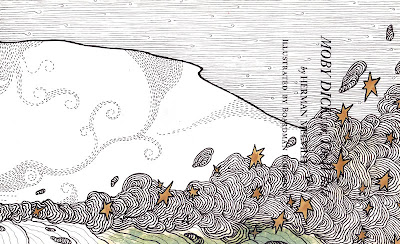
In the meantime, here's a collection of Moby-Dick cover art, some old, some new, some imaginary:


All Moby, no -Dick

I generally turn a blind eye to "customized" ads on social media sites, but a few days ago the above (on Facebook) caught my attention for several reasons, not the least of which is the presumption on the part of the editor that he was capable, with his gentle hand, of making Moby-Dick more "enjoyable" than Mr. Melville intended it to be. (That missing hyphen in the Readable Classics edition of the book must've been the first stumbling block to enjoyment. Nothing sours my reading pleasure more quickly than a hyphen.) Of course, any editor willing to mash up Pride & Prejudice and Moby-Dick, and then give himself top-billing on the dust jacket, is obviously not lacking in presumption. Or, more charitably, gumption.

Here's a sample of the first chapter of the more readable novel, which at least keeps in tact the greatest opening sentence in American literature:
Call me Ishmael.

Some years ago, having no money in my purse and nothing to interest me on the shore, I thought I would sail around a little and see the watery part of the world.

It is my way of driving off the gloom. Whenever it is a damp, drizzly November in my soul, or when I find myself following every funeral I see, and especially when I feel like stepping into the street and knocking people’s hats off--then I know it is high time to get to sea as soon as I can.

Instead of putting a pistol to my head, I quietly take to the ship. There is nothing surprising in this. If men would only admit it, they would have nearly the same feelings toward the ocean as I.
And here's the opening of Melville's weird, digressive, and labyrinthine masterpiece, with the excised or emended--in other words, the less readable--bits faded:
Call me Ishmael. Some years ago - never mind how long precisely - having little or no money in my purse, and nothing particular to interest me on shore, I thought I would sail about a little and see the watery part of the world. It is a way I have of driving off the spleen, and regulating the circulation. Whenever I find myself growing grim about the mouth; whenever it is a damp, drizzly November in my soul; whenever I find myself involuntarily pausing before coffin warehouses, and bringing up the rear of every funeral I meet; and especially whenever my hypos get such an upper hand of me, that it requires a strong moral principle to prevent me from deliberately stepping into the street, and methodically knocking people's hats off - then, I account it high time to get to sea as soon as I can. This is my substitute for pistol and ball. With a philosophical flourish Cato throws himself upon his sword; I quietly take to the ship. There is nothing surprising in this. If they but knew it, almost all men in their degree, some time or other, cherish very nearly the same feelings towards the ocean with me.
I'm not going to get into the ethics or aesthetics (or lack thereof) of such bowdlerization--I'm sure there are a few philistines readers who find such abridgements helpful and time-saving. I will simply point out a project translator and author Damion Searls undertook a few years ago, published as a special issue of the Review of Contemporary Fiction, in which he composed a text of everything--words and punctuation--left out of a similar helpful abridgement of Moby-Dick (called Moby-Dick in Half the Time). As you can see below, Searls titled his edition ; or the Whale.

Who has time to learn what a semi-colon is, anyway.