Edmund White, an appreciation

by Green Appler Kevin Davis

This month I’m celebrating the publishing event of Sacred Monsters--a collection of Edmund White's “New York Review of Books” essays--and Jack Holmes and his Friend, a romance novel heavily informed by White’s pre- and post-Stonewall Manhattan life.

I have lived vicariously through this pioneer of gay sensibility in literature, who is also a generous, astringent critic with a monumental breadth of literary knowledge, entrenchment in high culture, and even friendships with late 20th century East Coast artistic luminaries.

White, who chairs Princeton’s Creative Writing Department, has lived a rarefied life by his pen in places like Rome, Key West, and the Ile Saint-Louis by cultivating wealthy patrons and grants.

In Monsters, White breathtakingly weaves criticism with biographical details that illustrate the wider story behind 20 artists and writers--Isherwood, Mapplethorpe, John Rechy, to name a few.

In his review of Paul Bowles’s The Sheltering Sky, a standout, White recalls the death of his lover in Morocco’s Atlas Mountain harrowingly wrought in his The Married Man.

Mr. White, who is 25 years my senior, first educated me at age 16 at San Diego’s Fashion Valley mall Waldenbooks on Christmas Eve, when I read his pointed instructions on the, to me, exotic gay men’s ritual of cruising.

He appeared again in timely fashion, to illuminate both our shared community and his own authentic, intricate emotional exploration when I read The Beautiful Room is Empty at age 27 in (former rare book dealer) Dr. Jack Collins's Queer Lit class at City College. The specific resonant events White illustrates from his young adulthood, are not so appropriate for this family medium though.

Today I still read White like those guys paint the Golden Gate Bridge. I read from one end of his memoir trilogy-- A Boys Own Story, Beautiful Room, and Farewell Symphony -- to the other, and back again. The consequences for me of foolishly opening a White title at bedtime is bleary sleep deprivation upon awakening. I am spellbound, entranced.

I’m not an open-minded, well-rounded reader, though. I tried Hunger by Knut Hamsun, a White progenitor who shares his exquisite cognitive honesty, only Hamsun operates in Nowheresville, Norway instead of Manhattan’s Chelsea Neighborhood, or Venice, and has no leather bars or casual sex to speak of.

I believe if one is lucky enough in life to discover one sympathetic artist applying his talent to elevate the customs and relationships of one’s tribe, well, that’s all I need.

Mr. White played a role in a mortifying event from my halting arts reporting “career.” I was given an open-ended 20 minutes of phone time in connection with a review I wrote of White’s 2006 memoir, My Lives. I crafted sweeping, informed questions, to convey my respect, and then out of nowhere, he turned the tables and asked, “Do you write?”

Flustered, I guffawed merrily. No, I don’t write in the sense that this Guggenheim fellow, and French Officier de L’Ordre des Arts et des Lettres, writes. But, tragically, I responded with one of those tactless, horrifying non sequiturs I’ve been guilty of many times which I now recall like a grisly slow-motion accident. I responded blithely, “Gosh your voice is so effeminate,” and laughed again.

Well, it really was high pitched, not the timbre I expected from one of the Great Men of Letters.

The newly created Magnus Books published Sacred Monsters under the aegis of esteemed longtime editor Don Weise, formerly of Carroll and Graf. Weise, who chose all the collection’s essays, was recently one of “Out” Magazine’s 100 most powerful gay people.
Book of the Month: The Orphan Master's Son

It doesn't arrive until tomorrow, but The Orphan Master's Son by Adam Johnson is Green Apple's Book of the Month for January 2012. Why, you may ask?


Or here's Kevin Ryan's shelf talker:

Adam Johnson has said (I’m paraphrasing) that not every writer has a story to tell, and that not every person with a story to tell has the skill to write it, so writers must tell their stories for them. In The Orphan Master’s Son, Johnson tells the story of Pak Jun Do, raised in a North Korean orphanage. Citizens in the DPRK not only don’t enjoy freedom of the press and freedom of assembly, they truly don’t have access to freedom of thought, closed off as they are from the outside world and force fed a steady diet of propaganda. This brilliant, thoroughly-researched novel imagines life in that country, from citizens forced to “volunteer” to carry goats to the roof of their apartment building to be raised for food, to the horrors of the gulag, where dying prisoners are drained of their blood. But far from being a mere documentary of life in the DPRK, this is a hugely entertaining, often hilarious novel of assumed identity, casual cruelty, and collective delusion. Includes perhaps the greatest love scene ever to be written in jingoistic propaganda (“At length, in depth, their spirited exchange culminated in a mutual exclaim of Party understanding.”).

It arrives Tuesday, January 10, and you can buy it here or in the store. And here's the eBook version, if that's how you roll.

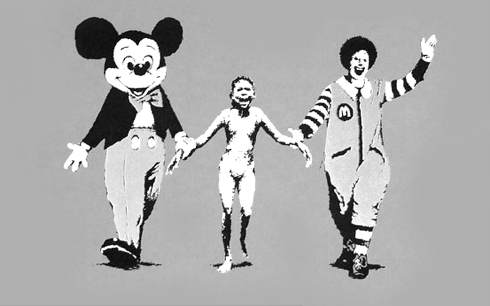
Brandalism


Its always seemed odd to me that i would have such an interest in branding and advertising. Im rebellious in nature, the type that wants to do the opposite of what im told and mocks authority, rules, and played out traditions. So to be really drawn to a world that preaches a message to a wide audience of others (advertising) and helps people take other peoples money and making them feel good about it (branding) has been perplexing. For the longest time i havent been able to figure out why this is. How could i find "brandalism" so disgusting and corruptive, but still want to bring these things to other people and enjoy it?

I believe now what draws my artistic interest to all this is control. Or better yet a chance to change things for the better. I think it was Milton Glazer who said something like "a designers job is to fight against ugliness". Thats why i like branding so much, because as a freelance designer you get to take on the clients and projects you want. You get to start with good people, with a good message and product. Then, you get to make their identity look badass. You dont have to accept the job from some sleazy douche bag with shitty product whose entire message/campaign is based on a fallacy.

When i can work with people who genuinely care about their customers and making a positive impact on the world, thats when i love what i do the most. Those who want to push some status quo are even better. Those people make the world a better place and i like making other people aware of them through art and design. Thats the whole control aspect of it for me. When i see a fast food billboard advertising some bullshit "made with real" product on the same block as an elementary school, thats when i get pissed and despise advertising and branding. Thats "brandalism". And fuck that.

On Not Reading


To be with the one I love and to think of something else: this is how I have my best ideas, how I best invent what is necessary to my work. Likewise for the text: it produces, in me, the best pleasure if it manages to make itself heard indirectly; if, reading it, I am led to look up often, to listen to something else. I am not necessarily captivated by the text of pleasure; it can be an act that is slight, complex, tenuous, almost scatterbrained: a sudden movement of the head like a bird who understands nothing of what we hear, who hears what we do not understand.
Roland Barthes, The Pleasure of the Text

For being an easily distracted person, I've always sought out somewhat distracting environments in which to read. Some of this impulse is nostalgic -- reading to the sound of a football game on TV or clattering dishes, for example, are comforts from childhood -- and sometimes it feels necessary to have the extraneous noise to tune out to give me incentive to narrow my focus.

Last night, though, while reading what is so far a very good book in such an environment, I suddenly sat up straighter with a startled feeling, like I'd just come around a corner in my own brain and caught myself doing something that always makes me feel guilty. People don't often admit to this, but they do it too, right? I realized that for at least a few pages, I hadn't really been reading.

The practice that I'm referring to is different from drifting off while reading, staring at the page thinking other thoughts. I was, actually, moving my eyes from line to line. Probably every sixth sentence entered my brain in a real, resonating way. I turned the pages at my regular pace. I wasn't really listening to anything going on around me. I wasn't thinking about anything else in particular, just occasional thoughts coming and going, like they always are. I was simply reading without reading.

I'll be honest: this happens a lot.

This confession would probably confuse some of the people who think of me as a reader. I've often been told how absorbed I appear by books, how specifically and passionately I speak about them, how much I seem to enjoy reading, and it's true -- there are few things in the world I like more. But, just like sometimes we read to escape, sometimes to learn, sometimes to entertain, I think we must admit that sometimes we read just to be reading, and that this sort of reading is not an exclusive mental activity. There is shame in this, like we're doing it wrong, right? But is this kind of reading less valuable than any other? I enjoyed the experience, I felt satisfied with my progress in my book (which, no, I will not name, lest I recommend it here sometime in the future and, despite my pleas that you understand this phenomenon, you think that I'm a faker and the book must be boring) and put it down with a desire to pick it up again soon. I'm not going to re-read those sentences I missed. I didn't need them. The ones I did need found their way in. Am I alone here? Or is this what reading is, and the part that I've been doing wrong is feeling like I'm always supposed to be doing it better?

Best-selling books of 2011

Here are the ten best-selling books at Green Apple for 2011 (with links to eBooks, just in case you're tying to fill up your new device).
  1. The Hunger Games by Suzanne Collins (young adult fiction, soon to be a movie). eBook
  2. A Game of Thrones: A Song of Ice and Fire by George Martin (the fantasy series adapted for HBO). eBook
  3. 1Q84 by Haruki Murakami (was it the free beer and tacos or just the pent-up demand for Murakmai's magnum opus?). eBook
  4. A Visit from the Goon Squad by Jennifer Egan (Green Apple was mentioned by name in the advance reading copy, only to be heartlessly edited out, alas). eBook
  5. A Clash of Kings by George Martin (as above). eBook
  6. Infinite City by Rebecca Solnit (we love when an eclectic university press book hits the top of our charts).
  7. Bossypants by Tina Fey (no one had ever heard of her until we started handselling this, right?). eBook
  8. Just Kids by Patty Smith (the Pulitzer didn't hurt). eBook
  9. A Storm of Swords by George Martin (yep, another one). eBook
  10. A Feast for Crows by George Martin (and another). eBook
Since George Martin nabbed four spots, let's list one more, eh?

11. Go the Fuck to Sleep by Adam Mansbach (proving that even if you can read a PDF free online, you still want the book. Or that parents today are horrible monsters).

No predictions for 2012, except maybe that this great book, which I'm currently devouring, will be much talked about. Now back to the stack of forthcoming books. . . .